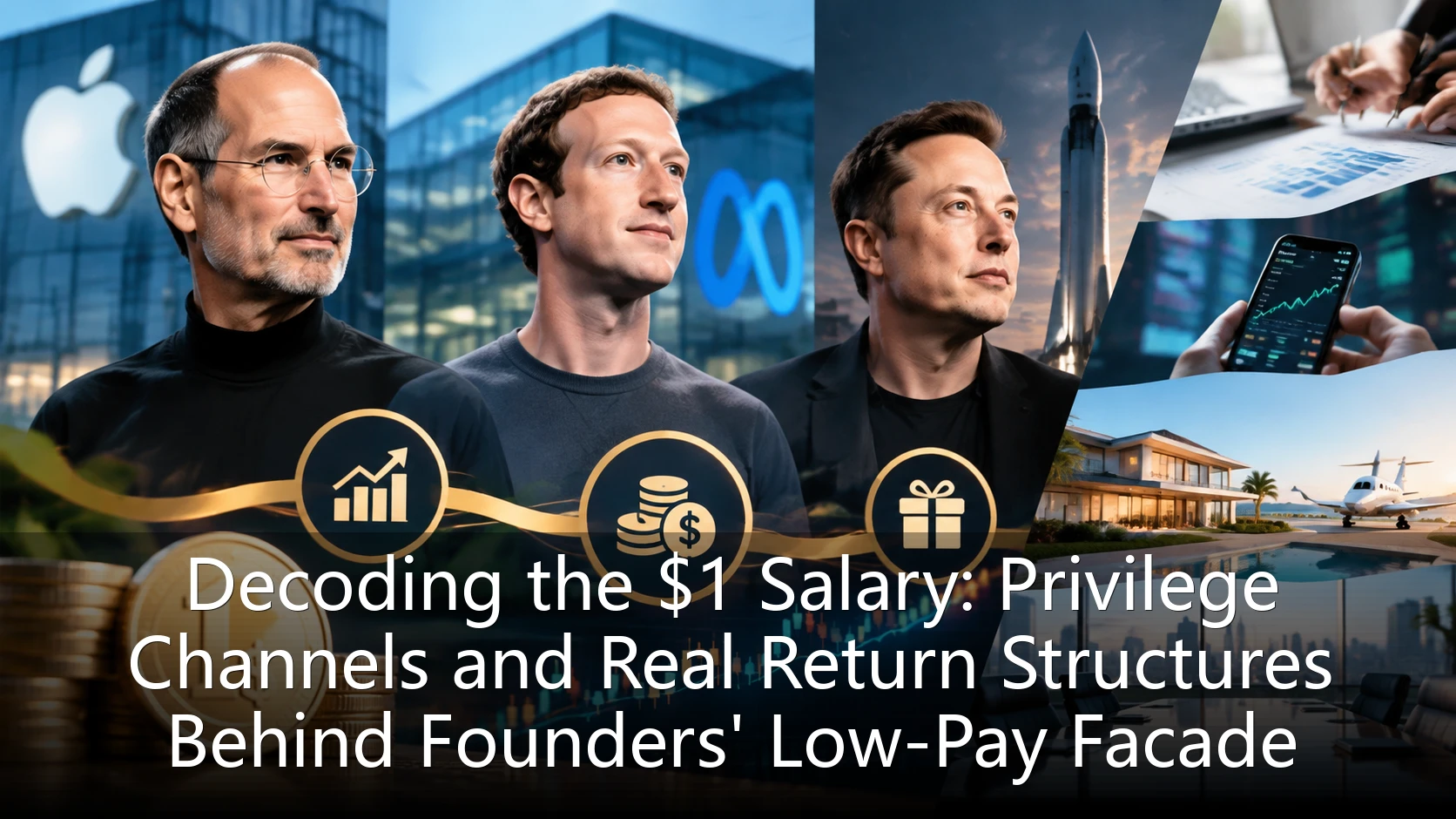
On the executive pay lists of listed companies, a curious phenomenon keeps recurring: a group of all-powerful company founders with a symbolic $1 in the salary column. This was true for Jobs after returning to Apple, for Zuckerberg in Meta's annual proxy statements for years, and for Google's two founders long after the IPO; China, too, has seen well-known entrepreneurs announce they would take only $1 a year for a decade. On the surface, it reads as a heartwarming tale of founders standing shoulder to shoulder with their company; from a deep capital research perspective, however, the $1 salary is more like the tip of an iceberg—a carefully designed return structure surfacing. This article systematically dissects the real privilege channels behind the low-pay myth and offers investors a practical reading framework.
1. The Low-Pay Facade: Sentiment Narrative or Tax Rationality?
First, a misconception must be cleared up: a $1 salary does not mean taking nothing. For founders with extremely high ownership stakes, cash wages are precisely the least efficient part of the return structure. In mature markets, the marginal tax rate on high earners' wages typically sits in the top bracket, while appreciation on long-held stock enjoys significantly lower capital gains tax; for unsold equity, gains can even sit on the books for years, with tax obligations triggered only upon sale. In other words, shifting compensation from the wage column to the equity column is itself an explicit tax optimization.
Second comes a layer of signaling value. By forgoing cash compensation, a founder is effectively telling capital markets: my wealth is deeply tied to the company's long-term value, and I am not seeking short-term cash-outs. During fundraising, listing, or transformation periods, such a stance can effectively reassure outside shareholders. For investors, however, the right reading is not to be moved but to ask: if the salary column is empty, where does the money come from? The answer usually lies hidden in three implicit channels.
2. Three Hidden Wealth Channels
1. Equity Incentives: Turning the Pay Table into Market-Cap Milestones
The most representative case is Tesla. Musk takes no fixed salary at Tesla; his compensation consists almost entirely of tranches of options that vest in stages, each tied to market-cap targets and operational milestones—achieve them and they pay out; miss them and they are worth nothing. On the surface this structure is highly binding, but in substance it is a massive call option: if the market cap stays flat, the founder receives nothing and the company bears almost no cash cost; once the market cap crosses key thresholds, the rewards run into the tens of billions of dollars. It changes three things at once: share-based payment expense on the income statement, the pace of share dilution, and the founder's natural appetite for aggressive expansion. Milestone-based pay is not necessarily bad, but it requires investors to simultaneously assess whether management has an incentive to steer results toward those milestones.
2. Stock Pledges: Monetizing Without Selling
Founders rarely sell shares, yet they are not necessarily short of cash. By pledging shares to financial institutions for loans, a founder can gain substantial liquidity without selling, without triggering capital gains tax, and without sending a bearish signal to the market—using it to buy assets, invest in new ventures, or even build positions in other companies. This channel runs smoothly in bull markets, but risks concentrate in bear markets: a sharp share-price decline can trigger margin calls or even forced liquidation, and passive selling pushes prices down further, creating a chain reaction that can shake the stability of corporate control. Share pledge disclosures in proxy statements are therefore the page least to be skipped when assessing governance risk in founder-led companies.
3. Perk Privileges: Hidden Costs Inside 'Other Compensation'
In a corner of the pay table there is usually another line: other compensation, the concentrated display zone of founder privileges—private security, use of corporate jets, residence and facility expenses, related-party transactions, and more. Take Zuckerberg: Meta's proxy statements over the years have disclosed security and private-jet spending that consistently ranks near the top among US-listed executives, far exceeding his $1 salary. These costs are borne by the company and paid for by shareholders—privileges that are legal but must be seen. The size and growth of the perks list often reveals the true power relationship between founder and board better than the salary does.
3. A Governance Lens: How to Read a $1 Salary
For investors, a $1 salary should be treated as a sample awaiting dissection, not a medal of virtue. Here are four core tests:
- Look at total pay, not base salary: Add up wages, bonuses, equity incentives, and other compensation to get the founder's real annual return, then compare it with net profit and shareholder returns.
- Look at the dilution pace: Track the expansion of shares outstanding and the option pool to judge whether the so-called incentives are quietly diluting minority shareholders' interests.
- Look at pledge disclosures: The higher the pledge ratio, the more directly share-price swings transmit to control; forced-liquidation risk in extreme markets must be priced into valuations.
- Look at compensation committee independence: If the nominating and compensation committees are mostly staffed by founder-friendly insiders, the rigor of milestone terms deserves a question mark.
4. Risk Checklist: Three Hidden Dangers of Low-Pay Structures
- Distorted incentives: When all returns hinge on the stock price, chasing short-term market-cap metrics may come at the expense of R&D and long-term investment.
- Pledge chain reactions: Highly leveraged holdings amplify volatility in downturns, and a founder's personal financial distress can spill over into a corporate governance crisis.
- Absent exit mechanisms: When low pay, high power, and high ownership stack up without sunset clauses, the founder's personal preferences override checks and balances for years, and succession is systematically deferred.
5. Reducing the Myth to a Financial Statement
A $1 salary is neither charity nor conspiracy; it is a rational choice of return structure: the founder deeply binds personal wealth to the company's stock price while letting privileges grow in subtler ways. For investors, what matters is not moralizing from on high but returning to four plain questions—where does the cash go, how is equity granted, how much is pledged, and when does power exit? Answer these four clearly, and the low-pay myth automatically reduces to an assessable risk-return statement. In an era of dual-class shares and ever-expanding founder power, learning to read the full ledger behind a $1 salary is the first lesson in investor self-protection.