The Ultimate Defense for Starlink's IPO
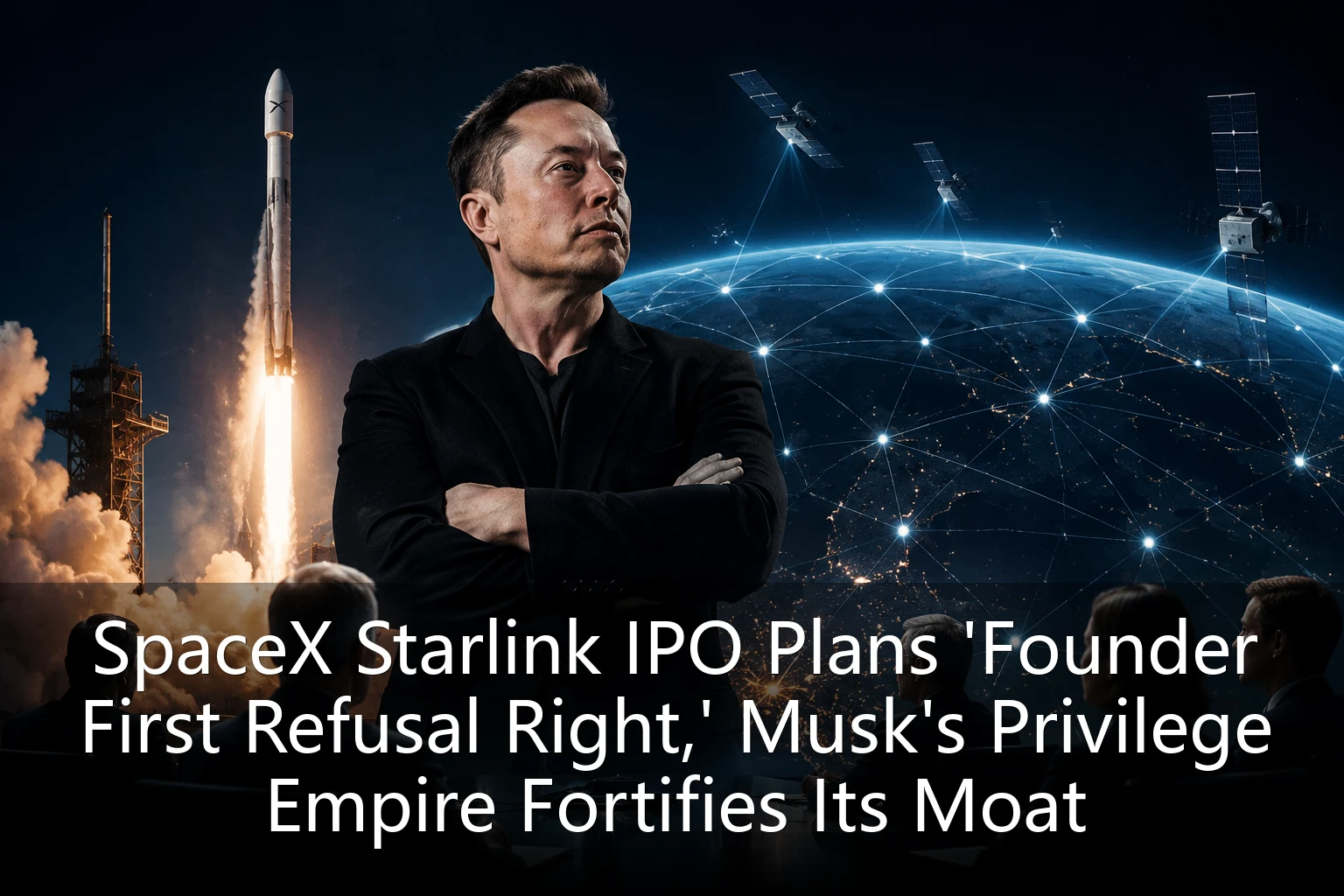
As capital markets hold their breath for one of the largest tech IPOs in history, Elon Musk has once again demonstrated his extreme understanding of 'founder privilege' to Wall Street. On August 2, 2026, according to multiple sources close to SpaceX's board, the soon-to-be spun-off Starlink not only continues the 'unequal voting rights' design common in Silicon Valley at the top level but also embeds a highly disruptive clause in its shareholder agreement—Founder First Refusal and Call Right. This is not just a simple extension of the dual-class share structure but pushes founder privilege from 'controlling votes' to the deeper dimension of 'controlling the chips' themselves.
Priority Repurchase Right: Ultimate Control Beyond Voting Rights
The traditional dual-class share structure addresses the question of 'who has the final say,' granting founders 10 or even 20 votes per share to ensure they retain board control even after equity dilution. However, the clause Starlink plans to introduce targets the core of the capital market—liquidity.
It is reported that the clause stipulates: after a specific lock-up period following Starlink's listing, if any non-founder affiliate (including current and former employees holding options, and external institutional investors) wishes to sell their shares, Musk and his designated entities have the right to exercise a 'right of first refusal' under the same conditions. Even more astonishingly, under certain triggering conditions (such as the company deeming a shareholder a potential threat to its long-term strategy), Musk can even forcibly repurchase these shares at a price 15% to 20% above the current market price, or directly at the higher of the IPO issue price.
This mechanism is extremely rare in capital markets. Previously, preemptive rights typically appeared in shareholder agreements during private placement stages and were mostly pro-rata rights protecting all shareholders. The Starlink version centralizes and personalizes this right, adding a mandatory attribute with a 'punitive premium.' From the perspective of founder rights, this is akin to building an unsinkable lifeboat for Musk in the vast ocean of the capital market; any external takeover attempt that could shake his control faces the 'nuclear deterrent' of being instantly bought out at a high price.
Governance Debate: Vision Protection or Power Abuse?
Supporters view this move as a 'necessary evil' for Musk to defend his vision of Mars colonization. Since Starlink's profit model heavily relies on the reuse of super-heavy rockets and the future construction of an interplanetary communication network, the company must endure massive short-term losses that the capital market struggles to understand. Without such extreme control safeguards, activist investors could easily exploit stock price volatility to launch proxy fights, forcing the company to break up assets or change course.
However, Wall Street governance experts express deep concern. Former SEC Commissioner Jackson noted: 'This is not just an enhancement of unequal voting rights, but a substantial erosion of shareholder property rights. When a founder can decide who can hold stock and at what price they can exit, the fair value of the stock loses its meaning. This is tantamount to a potential wealth transfer by the founder using privilege.'
From an investment perspective, this mechanism directly leads to a 'liquidity discount' for Starlink shares. If this clause is implemented, large index funds and pension funds will face immense valuation challenges when allocating Starlink: are you buying ownership of the company, or merely a ticket subject to the founder's absolute will?
The Evolution of Dual-Class Shares: From Voting Rights to Survival Rights
Looking back at Musk's Tesla and SpaceX, his obsession with control is well-documented. From Tesla's 2018 compensation plan to the subsequent controversy over its reincorporation, Musk has repeatedly proven his willingness to engage in high-stakes battles with the capital market for control. The Starlink IPO plan shows Musk is pushing founder privilege to a new height—evolving from 'voting rights' to 'survival rights'.
The logic of this evolution is that in the era of AI and the space economy, the lifecycle of a super-enterprise is often deeply tied to the founder's biological clock. To prevent capital short-sightedness from stifling technological revolution, the founder must possess tools to veto capital's will. The danger, however, is that when this privilege completely escapes the checks and balances of the board and independent shareholders, the entire system lacks an error-correction mechanism if the founder makes a mistake.
For B-share investors, Starlink's innovative structure carries a strong warning. It breaks the traditional boundary where B-shares in a dual-class structure only lose voting rights, now encroaching upon the right to dispose of property of B-shares. If this model gains regulatory acquiescence in the US market, future Chinese concept stocks or B-share listed companies are highly likely to follow suit, introducing various disguised 'founder golden handcuffs.' When chasing high-growth companies, investors must re-examine the hidden discount brought by founder privilege and guard against the excessive expansion of this power under personal will.
As of press time, SpaceX has not commented on this clause, only reiterating that 'Starlink's listing is to make humanity a multi-planetary species, and we will take all necessary measures to protect this long-term mission.' This undoubtedly suggests that in Musk's interstellar journey, the storm surrounding founder privilege has only just begun.