In the hidden corners of the capital market, the boundaries of founder power are expanding at a pace beyond conventional imagination. While the public is still digesting the shock of dual-class share structures enabling "different rights for the same shares," founders of top tech companies have pushed their privileges to a deeper level—not by manipulating post-IPO voting rights, but by building an iron wall around pre-IPO "equity transfers."
The 'Golden Handcuffs' Behind a $300 Billion Valuation
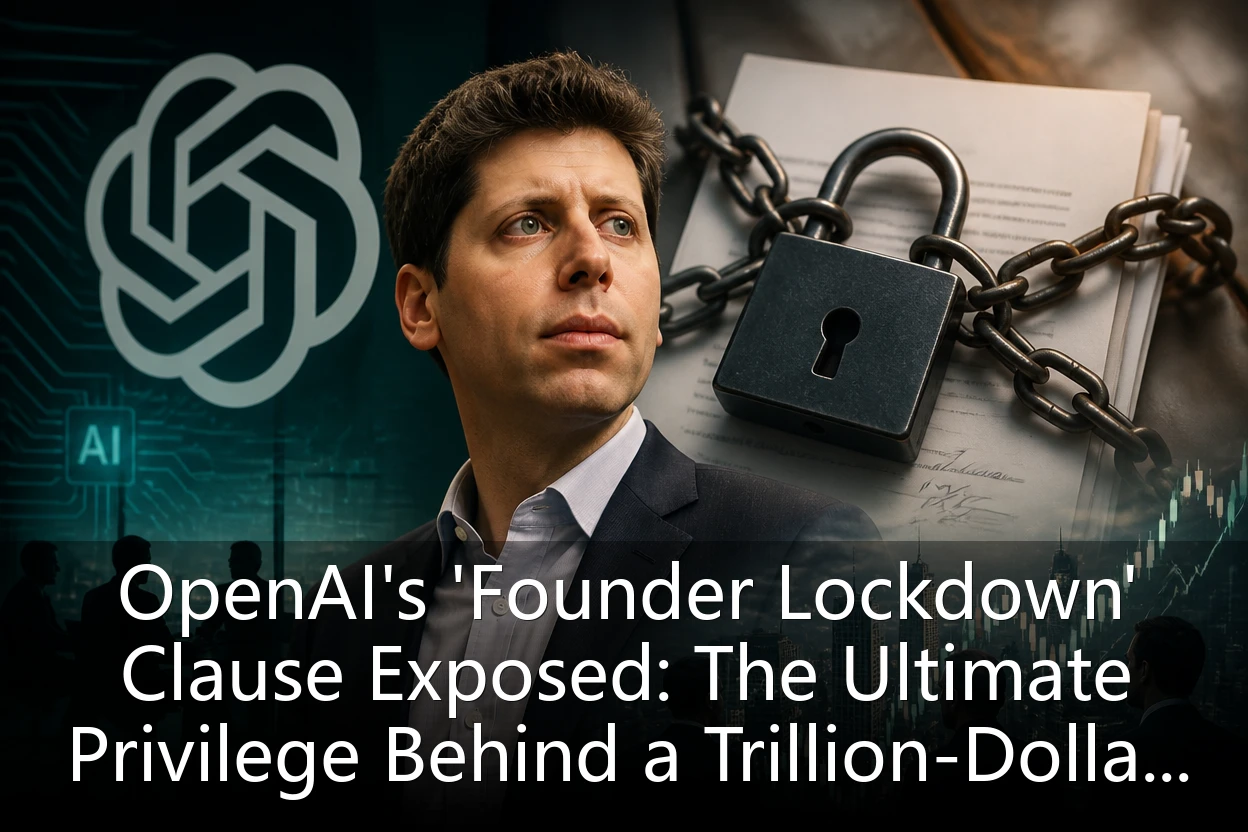
According to multiple Wall Street sources disclosed in early August 2026, AI giant OpenAI quietly embedded an extremely stringent "Founder Lockdown" clause in its latest $40 billion financing agreement. This clause differs from conventional lock-up periods in traditional corporate law, granting founder Sam Altman a near-absolute veto power over equity transfers.
Insiders revealed the core content of this clause: before OpenAI achieves a breakthrough in next-generation Artificial General Intelligence (AGI) or goes public, any external investor attempting to sell, pledge, or transfer their OpenAI shares must obtain written approval from Altman himself or his designated committee. What further stunned Wall Street is that the clause includes a "Right of First Refusal"—if Altman denies a transfer, he has the right to forcibly repurchase those shares at a "discounted price based on the previous round's valuation."
The Evolution of Privilege: From 'Controlling Votes' to 'Controlling Exits'
Looking back over the past two years, we have deeply analyzed cases like Nvidia and SpaceX, where super-voting share structures grant founders dozens of times the voting power. However, OpenAI's move marks a new dimension of founder privilege—liquidity control.
Traditional founder privileges mostly focus on "management rights" and "voting rights." Even with rigid dual-class structures, investors, while losing voting power, still retained the economic freedom to dispose of their property (shares). OpenAI's "lockdown clause," however, directly touches upon investors' core property rights. An anonymous senior Silicon Valley lawyer commented: "It's like buying a luxury house, but the deed is in someone else's name, and without their permission, you can't sell it or even mortgage it. This completely changes the rules of the venture capital game."
Altman's Grand Strategy: Isolating Short-Term Conflicts of Interest
Why would Altman introduce such a forceful privilege clause now? Analysts point out it is closely related to the complex situation OpenAI currently faces. As a super-unicorn under the halo of a "non-profit mission," OpenAI is under immense internal pressure for commercial monetization. Some early investors and senior scientists holding options, facing a valuation of up to $300 billion, have long had a strong desire to cash out.
If rampant private secondary market transactions were allowed, it would not only fragment OpenAI's equity structure and make it difficult to manage, but could also trigger negative speculation about OpenAI's prospects due to early investors "jumping ship." Through this "Founder Lockdown" privilege, Altman forcibly binds all stakeholders to the same vessel, sending a strong signal: either reach the shore of AGI together, or no one gets to jump ship midway. This is seen as an extreme long-term strategy, but it is also tinged with authoritarian control.
The Gray Zone of Investor Rights and Legal Battles
The exposure of this clause immediately sparked intense ethical and legal controversy on Wall Street. Supporters argue that for a cutting-edge tech company like OpenAI, which concerns humanity's future, the founder must be granted absolute control to resist capital's short-sightedness. After all, between AI safety and commercialization, only the founder can hold the bottom line.
However, the opposition's voice is stronger. Several lawyers specializing in corporate governance point out that this "liquidity lockdown" may touch upon a gray zone in investor protection. In non-listed companies lacking a public market pricing mechanism, prohibiting share transfers essentially deprives investors of their rights to cut losses and realize gains. If Altman uses the "discounted price right of first refusal" clause, it could even evolve into a legal tool for wealth extraction—forcing investors to sell their shares to him at a low price by suppressing the valuation, thereby significantly increasing his own stake before an IPO.
What worries institutional investors even more is that this aggressive founder privilege is being imitated. Reportedly, more than one late-stage AI startup is quietly copying similar "founder veto" clauses in their term sheets. For capital accustomed to voting with their feet, this is undoubtedly a nightmare.
Buguzhishi Insight: Reshaping Investment Logic Behind Privileges
In Buguzhishi's long-term tracking of dual-class shares and founder privileges, the OpenAI case undoubtedly sets a new milestone. It reminds all investors that in the feast of chasing high-valuation unicorns, one must not only look at voting rights ratios but also carefully scrutinize the "hidden clauses" in the corporate charter.
For ordinary investors, although they cannot directly participate in OpenAI's primary market financing, this governance model will inevitably be transmitted to future IPO pricing. A company where the founder has absolute "lockdown power" will see its secondary market liquidity premium significantly discounted, and may even trade at a notable discount due to governance risks. On the path to decrypting founder privileges, we must see not only the halo of power but also the shadows beneath it. When a founder's control extends from "governance" to "property," investment safety faces unprecedented challenges.