2026 Global Dual-Class Equity New Landscape: Regulatory Tightening and Value Rebalancing
\nIn the wave of change in the global capital market in 2026, dual-class equity structures are undergoing unprecedented regulatory restructuring and value reassessment. With major global regulatory bodies such as the SEC, HKEX, and SGX successively introducing new regulations for dual-class equity companies, the AB share structure, once considered a "privilege tool" for founders, is moving toward a more transparent and standardized governance era. This transformation not only reshapes the balance between founder control and investor rights but also brings new opportunities and challenges for global investors.
\n\nDual-Class Equity Structure: From Silicon Valley Privilege to Global Phenomenon
\nDual-class equity structure, or AB share system, allows companies to issue shares with different voting rights, where founders typically hold B-class shares with multiple voting rights, while ordinary investors hold A-class shares. This structure emerged in Silicon Valley tech companies in the 1980s, aiming to help founders maintain control over their companies during the financing process. Tech giants like Meta (formerly Facebook), Google, and Tesla have all adopted this structure, enabling their founders to long-term dominate the company's strategic direction.
\nHowever, with the popularization of dual-class equity structures, the governance issues they have triggered have become increasingly prominent. By 2026, the number of companies adopting dual-class equity structures worldwide has grown by nearly 300% compared to ten years ago, mainly concentrated in high-growth industries such as technology, biotechnology, and new energy. Behind this rapid growth is an increasingly intense game between founder control and investor protection.
\n\nGlobal Regulatory New Trends: Sunset Clauses Become Standard
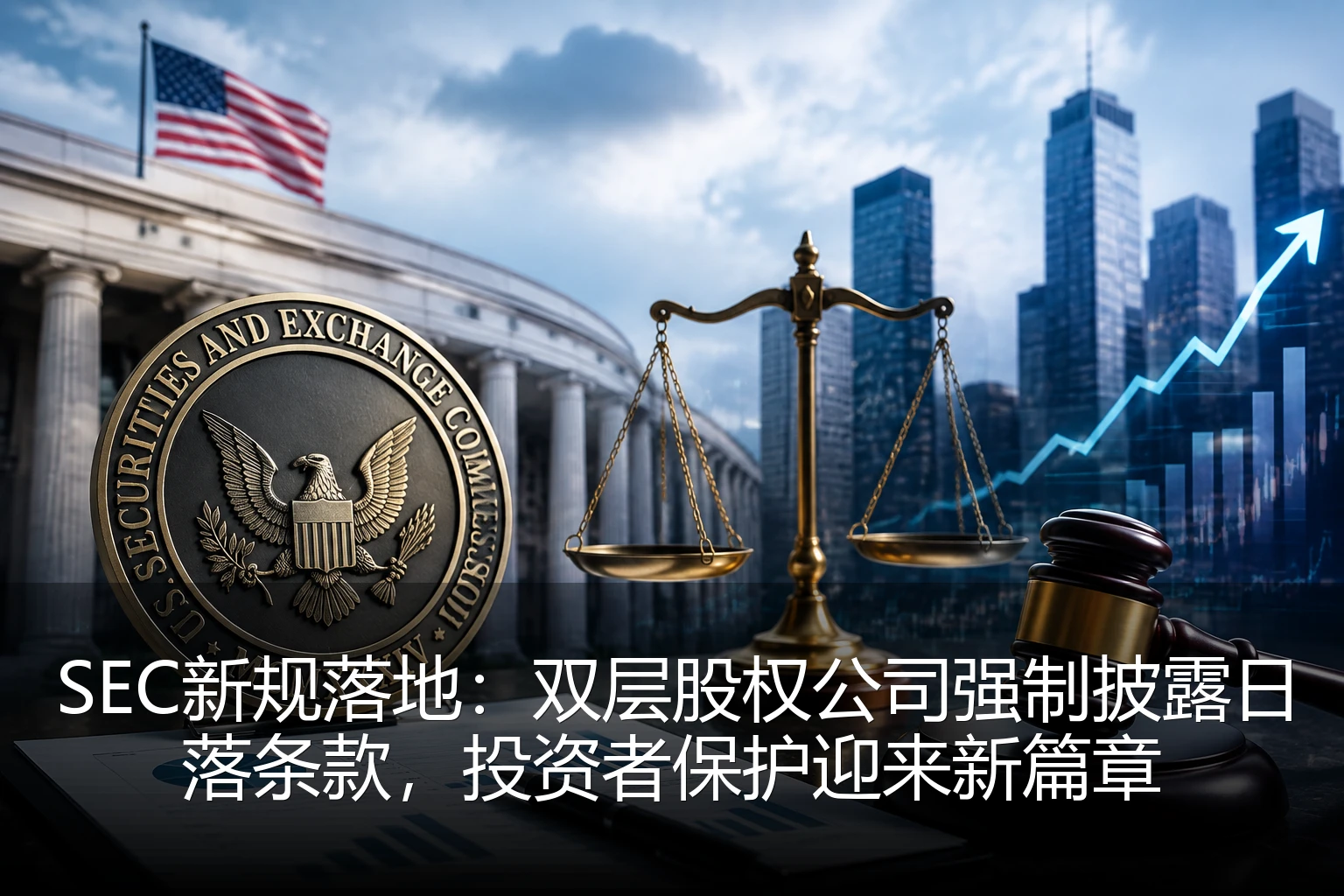
\nIn 2026, global regulatory agencies have significantly shifted their stance on regulating dual-class equity structures. The U.S. SEC formally implemented the "Dual-Class Company Sunset Clause Mandatory Disclosure Rules" at the beginning of the year, requiring all listed companies with dual-class equity structures to clearly disclose the specific arrangements of sunset clauses, including trigger conditions and implementation timetables.
\nThis new regulation marks the SEC's shift from "laissez-faire" to "standardized" regulation of dual-class equity structures. According to SEC data, by the third quarter of 2026, 87% of dual-class equity listed companies had established sunset clauses, a significant increase from 35% in 2021. Sunset clauses typically stipulate that when a company reaches a specific development stage (such as 10 years after listing) or a certain market capitalization, the super-voting rights of B-class shares will automatically convert to the same voting rights as A-class shares.
\nMeanwhile, major Asian exchanges have also followed suit. The Hong Kong Stock Exchange issued new listing guidelines for dual-class equity companies in June 2026, further tightening the listing threshold for such companies, requiring applicants to demonstrate the necessity and rationality of sunset clauses and commit to gradually achieving equal voting rights as corporate governance matures. The Singapore Exchange, in March 2026, became the first to introduce a "mandatory sunset clause implementation" policy, requiring all new dual-class equity listing applicants to clearly specify the implementation timetable for sunset clauses in their prospectuses.
\n\nCase Study Analysis: From Tech Giants to New Energy Vehicle Companies
\nIn 2026, several well-known companies have adjusted their dual-class equity structures, reflecting the market's rethinking of this system.
\nIn April 2026, NVIDIA announced that it would adjust its 20:1 super-voting rights to 10:1 and commit to initiating sunset clause evaluation when the company's market capitalization reaches $1 trillion. This adjustment was interpreted by the market as a positive signal from founder Jensen Huang to investors while maintaining control. NVIDIA's stock price rose by 5.3% after the announcement, showing market recognition of this balancing mechanism.
\nAnother notable case is Tesla. In February 2026, Tesla announced that it would adjust the 10:1 super-voting rights of its B-class shares to 5:1 and set a sunset clause, which would trigger an evaluation of equal voting rights after the company achieves consecutive five years of net profit growth and exceeds a market capitalization of $500 billion. This adjustment was seen as Musk's response to some investors' concerns about corporate governance while maintaining control over Tesla's strategic direction.
\nIn the new energy sector, Chinese new energy vehicle company NIO adopted a dual-class equity structure when listing in the U.S. in July 2026, but its sunset clause design was more aggressive, stipulating automatic equal voting rights 8 years after listing, far shorter than the industry average of 12-15 years. This design was considered by analysts as a key measure to attract international investors and provided a new governance model for Chinese concept stocks listing in the U.S.
\n\nRebalancing Investor Protection and Founder Control
\nThe core controversy of dual-class equity structures lies in the balance between founder control and investor protection. In 2026, with the improvement of regulatory policies, this balance point is undergoing subtle changes.
\nOn one hand, the popularization of sunset clauses has significantly enhanced investor protection. According to research data from Bushu Zhishi, dual-class companies with clear sunset clauses showed an average 12.7% higher long-term stock price performance (3-5 years after listing) compared to companies without sunset clauses, indicating market recognition of investor protection mechanisms.
\nOn the other hand, the value of founder control is still recognized by the market. Technology companies adopting dual-class equity structures have shown outstanding performance in innovation capabilities and long-term strategic execution. In the first half of 2026, technology companies with dual-class equity structures had an average R&D investment to revenue ratio of 18.3%, significantly higher than the 12.6% for companies with equal voting rights in the same industry.
\nThis "control premium" is particularly evident in the artificial intelligence field. In June 2026, OpenAI's parent company, which adopted a 20:1 super-voting rights structure, completed a new round of financing with a valuation of $150 billion, far higher than competitors in the same industry that did not adopt dual-class equity structures. This indicates that in industries highly dependent on long-term strategic investment, founder absolute control is still regarded as a key factor in creating value.
\n\nInvestment Strategy Adjustment: From Risk Avoidance to Value Mining
\nFacing the new landscape of dual-class equity structures, investors need to adjust their investment strategies, shifting from simple risk avoidance to in-depth value mining.
\nFirst, investors should pay more attention to the design details of sunset clauses. Bushu Zhishi analysts suggest that investors should focus on evaluating whether the trigger conditions of sunset clauses are reasonable, whether the implementation timetable is clear, and whether the corporate governance mechanism is sound. For example, whether the sunset clause matches the company's development stage, whether a reasonable transition period is set, etc.
\nSecond, investors need to reassess the value of founder control. In innovation-driven industries such as technology and biotechnology, founders' strategic vision and execution ability are often crucial to the company's long-term value creation. Investors should pay attention to the founder's past performance, industry reputation, and alignment with the company's values.
\nThird, the weight of ESG factors in investment decisions for dual-class equity companies is increasing. In 2026, more and more institutional investors are incorporating corporate governance, social responsibility, and environmental protection factors into their investment decision frameworks. For dual-class equity companies, ESG performance has become an important dimension in evaluating their long-term investment value.
\n\nFuture Outlook: Evolution Direction of Dual-Class Equity Structures
\nLooking ahead, dual-class equity structures will continue to evolve, showing several clear trends:
\n\n- \n
- Standardization of Sunset Clauses: With the unification of regulatory requirements, the specific content and implementation timetables of sunset clauses will tend to standardize, allowing investors to more clearly compare the governance arrangements of different companies. \n
- Dynamic Adjustment Mechanisms: Future dual-class equity structures may introduce more flexible dynamic adjustment mechanisms that automatically adjust voting rights structures according to the company's development stage and market environment changes, rather than fixed timetables. \n
- Industry-Differentiated Governance: Different industries may develop differentiated dual-class equity governance models. For example, the technology industry may maintain longer super-voting rights periods, while traditional industries may adopt shorter implementation timetables. \n
- Increased Investor Participation: With the improvement of regulatory transparency, investors' participation in the governance of dual-class equity companies will increase, and institutional investors may influence corporate governance decisions through active shareholderism. \n
The evolution of global dual-class equity structures in 2026 reflects the maturity and progress of capital markets in corporate governance concepts. Seeking a balance between founder control and investor protection will become a core issue in future corporate governance. For investors, understanding this evolutionary trend and grasping the new features of dual-class equity structures will help make more informed investment decisions in a complex market environment.
\n\nAs Buffett said at the 2026 annual shareholders' meeting: "There is no one-size-fits-perfect model for corporate governance. The key is to find a balance point suitable for the company's development stage and industry characteristics." The future of dual-class equity structures will be a continuous process of finding optimal solutions between control and value creation, innovation and stability, short-term interests and long-term development.